
Writing Effective Clinical Evaluation Reports (CERs)
This course provides structured, regulator-focused training on developing and maintaining Clinical Evaluation Reports (CERs) in line with EU MDR 2017/745, Annex XIV, and relevant MDCG guidance. Learners are guided through the complete clinical evaluation lifecycle, from defining scope and Clinical Evaluation Plans (CEP), identifying and appraising clinical data, to conducting evidence weighting, benefit–risk evaluation, and PMCF justification. The course explains how Notified Bodies assess CERs, common deficiencies raised during reviews, and how to ensure consistency and traceability across CER, RMF, PMS, PMCF, and IFU. Applicable standards and guidance such as MEDDEV 2.7/1 Rev.4, MDCG 2020-6, MDCG 2020-13, ISO 14155, ISO 14971, ISO 13485, IMDRF principles, and the ISO 18969 draft are integrated throughout. Each module includes five MCQs, available at the end of each submodule, to reinforce learning.
Link for learner's community:
https://neujinsolutions.heightsplatform.com/discuss/clinical-evaluation-learningA weekly live session is available. Please share your specific queries in advance through private message or email at neulearn@neujinsolutions.com. You will be informed of the date and time in advance.
The certificate will be issued upon successful course completion and receipt of your feedback.
42 Lessons
Already Joined? Login
Module 1 – Introduction & Regulatory Foundation
Introduces the purpose, regulatory basis, and lifecycle role of clinical evaluation and CERs under EU MDR.
Module 1A – Role & Importance of CER
Explains what clinical evaluation is and why it is a core regulatory requirement for medical devices.

Module 1B – Clinical Evaluators: Roles & Competence
Describes who clinical evaluators are and the competence requirements under MDR and ISO guidance.
Module 1C – Clinical Evaluation Lifecycle Workflow
Explains how clinical evaluation activities interact across the device lifecycle.
Module 2 – Stage 0: Defining Scope & Clinical Evaluation Plan
Covers CEP development, Article 61 routes, evidence sufficiency, SOTA, claims identification, and executive summaries.
Module 2A – Clinical Evaluation Plan (CEP) & Scope
Explains how to define scope and develop a compliant Clinical Evaluation Plan.

Module 2B – Article 61: Routes of Clinical Evaluation
Explains clinical evaluation routes permitted under Article 61 of the EU MDR.
Module 2C – Sufficient Clinical Evidence
Defines what constitutes sufficient clinical evidence under MDR and MDCG guidance.

Module 2D – State of the Art (SOTA)
Explains how SOTA is defined and applied in clinical evaluation.
Module 2E – MDCG Guidance Integration
Explains how MDCG guidance shapes CER expectations and NB reviews.
Module 2F – Claims Identification
Covers identification and regulatory control of clinical claims.

Module 2G – Executive Summary Writing
Explains how to write NB-focused CER executive summaries.
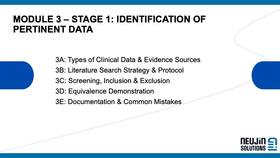
Module 3 – Stage 1: Identification of Pertinent Data
Covers systematic identification of internal and external clinical data required for CER development.

Module 3A – Types of Clinical Data & Evidence Sources
Introduces internal and external clinical data sources used in CERs.

Module 3B – Literature Search Strategy & Protocol
Explains how to plan and document reproducible literature searches.
Module 3C – Screening, Inclusion & Exclusion
Covers systematic screening and justification of included and excluded studies.

Module 3D – Equivalence Demonstration
Explains MDR requirements for demonstrating clinical equivalence.

Module 3E – Documentation & Common Mistakes
Covers documentation requirements and frequent NB findings in Stage 1.

Module 4 – Stage 2: Appraisal & Evidence Weighting
Focuses on appraisal, bias assessment, and evidence weighting for clinical data.

Module 4A – Appraisal Principles & Criteria
Introduces structured appraisal of clinical data.

Module 4B – Bias, Applicability & Study Quality
Explains bias assessment and applicability to the device under evaluation.

Module 4C – Evidence Weighting & Hierarchy
Explains how evidence is weighted based on quality and relevance.

Module 4D – Handling Poor-Quality & Conflicting Evidence
Covers regulatory handling of weak or conflicting data.

Module 5 – Stage 3: Analysis, Benefit–Risk & PMCF
Covers clinical data synthesis, benefit–risk evaluation, and PMCF planning.

Module 5A – Clinical Data Analysis & Synthesis
Explains synthesis of clinical evidence into regulatory conclusions.
Module 5B – GSPR Compliance & Traceability
Covers GSPR mapping and traceability requirements.

Module 5C – Benefit–Risk Evaluation
Explains structured benefit–risk assessment under MDR.

Module 5D – PMCF Planning & Justification
Explains when PMCF is required and how it is justified.
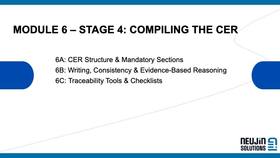
Module 6 – Stage 4: Compiling the CER
Covers CER structure, writing quality, and traceability checks.
Module 6A – CER Structure & Mandatory Sections
Explains required CER structure and content.

Module 6B – Writing, Consistency & Evidence-Based Reasoning
Covers regulatory writing principles for CERs.
Module 6C – Traceability Tools & CER Release Checks
Explains traceability tables and final CER checks.
Module 7 – Post-Release & Notified Body Interactions
Explains CER updates, NB reviews, and deficiency responses.
Module 7A – CER Updates & Triggers
Explains when and why CERs must be updated.

Module 7B – NB Review Process & Expectations
Explains how Notified Bodies assess CERs.

Module 7C – Addressing NB Deficiencies & Corrective Actions
Covers structured responses to NB findings.
Module 8 – Special CER Scenarios
Addresses complex CER scenarios such as software, legacy, and combination devices.
Module 8A – Software / MDSW CERs
Introduces CER requirements for software medical devices.
Module 8B – CERs for Legacy Devices
Explains evidence challenges for legacy devices under MDR.
Module 8C – CERs for Combination Products
Explains CER expectations for device–drug combination products.